

Is It Worth Repairing Broken Southwester Pottery
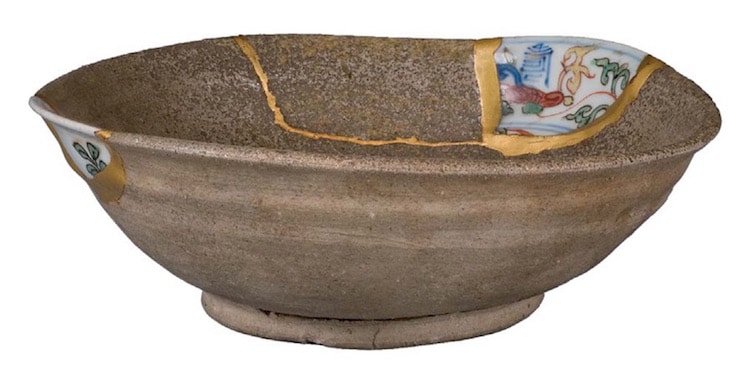
Poetically translated to"gilded joinery," Kintsugi , or Kintsukuroi, is the centuries-onetime Japanese fine art of fixing cleaved pottery. Rather than rejoin ceramic pieces with a camouflaged adhesive, the Kintsugi technique employs a special tree sap lacquer dusted with powdered gold, silverish, or platinum. One time completed, beautiful seams of gilded glint in the conspicuous cracks of ceramic wares, giving a one-of-a-kind appearance to each "repaired" piece.
This unique method celebrates each artifact's unique history by emphasizing its fractures and breaks instead of hiding or disguising them. In fact, Kintsugi frequently makes the repaired piece even more cute than the original, revitalizing information technology with a new wait and giving it a 2d life.
Here, we take a wait at this enchanting arts and crafts, tracing its history, exploring its methods, and offering a glimpse into how contemporary creatives go along it alive.
The History of Kintsugi
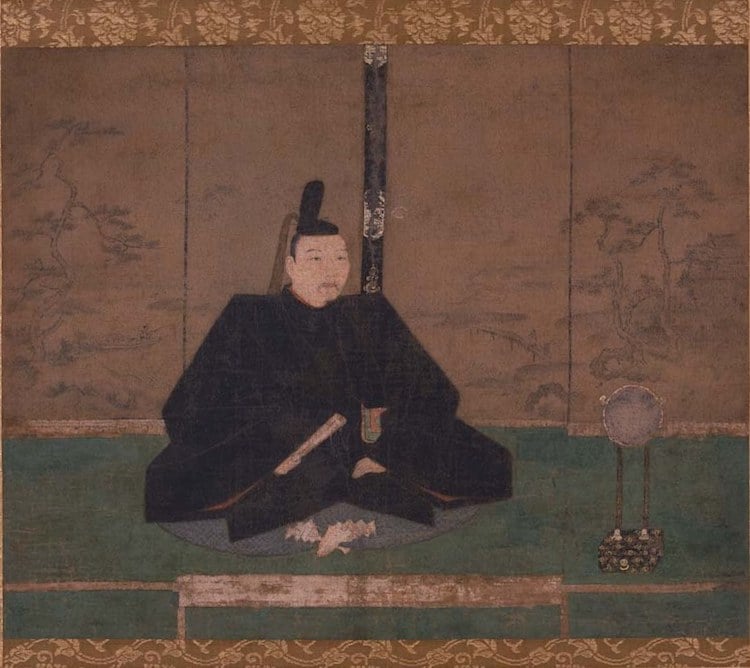
Portrait said to be of Ashikaga Yoshimasa, 15th century (Photo: Wikimedia Commons Public Domain)
While Kintsugi'south origins aren't entirely articulate, historians believe that it dates dorsum to the late 15th century. According to legend, the arts and crafts commenced when Japanese shogunAshikaga Yoshimasa sent a croaky chawan—or tea bowl—dorsum to Cathay to undergo repairs. Upon its return, Yoshimasa was displeased to discover that information technology had been mended with unsightly metal staples. This motivated contemporary craftsmen to notice an alternative, aesthetically pleasing method of repair, andKintsugi was built-in.
By the 17th century, Kintsugi has get common practice in Japan. According to Louise Cort (the curator of ceramics at the Freer Gallery of Art and Arthur M. Sackler Gallery), it was during this time that a Japanese warrior infamously purchased, bankrupt, and repaired standard tea bowls in order to make a profit."That seems to indicate that, by the beginning of the 17th century, kintsugi was a ordinarily used technique for repairing—and at the same time, ornamenting—ceramics for tea," Cort explains.
In addition to serving as an aesthetic principle, Kintsugi has long represented prevalent philosophical ideas. Namely, the practice is related to the Japanese philosophy of wabi-sabi , which calls for seeing beauty in the flawed or imperfect. The repair method was also born from the Japanese feeling of mottainai , which expresses regret when something is wasted, as well equally mushin , the credence of change.
Methods

There are iii predominant styles of Kintsugi: fissure, piece method, and articulation-call. While, in each instance, gold, argent, or platinum-dusted epoxy is used to set up the cleaved pottery, the techniques and finished results vary.
Cleft
Objects mended using the crevice arroyo are touched up with minimal lacquer. This is the nigh common Kintsugi technique, and information technology culminates in the shimmering veins that have come to ascertain the art grade.
Piece Method
Works restored with the piece method feature replacement fragments made entirely of epoxy.
Joint-Call
Pieces fixed using the joint-call technique employ similarly-shaped pieces from other cleaved wares, combining two aesthetically different works into one uniquely unified product.
Next: Kintsugi Today

Source: https://mymodernmet.com/kintsugi-kintsukuroi/
Posted by: kratzolonstake90.blogspot.com
0 Response to "Is It Worth Repairing Broken Southwester Pottery"
Post a Comment