

How Hard Is It To Get Pma After Getting A Repair Station
PMA vs. OEM: What Yous Need to Know

PMA vs. OEM: What Y'all Demand to Know
Amidst shipping parts distributors, the debate between parts manufacturer blessing (PMA) and original equipment manufacturer (OEM) parts can exist confusing and controversial. To empathize how both options work, it's important to larn virtually their past and current standards.
In some ways, these two types of parts have more similarities than you lot might await. The best option for your operational requirements will depend on the application, so you'll want to consider the advantages each type of part tin offer for your operations. In this mail, nosotros'll explore the meaning of PMA and OEM parts and compare the two and so y'all can brand an informed decision nigh your options.
What Is a PMA Part?
A PMA part is manufactured by a visitor with the approving of the Federal Aviation Administration (FAA). The FAA PMA designation demonstrates the company's authorization to produce aircraft parts that encounter industry standards. As an aftermarket part, this label means the product has received adequate testing that meets FAA standards for airworthiness. It also ensures the parts have been manufactured according to approved procedures from the FAA.
Historically, aftermarket products just emerged in the market afterwards World War 2, when consumers needed replacement parts for aircraft. At that fourth dimension, PMA parts became available for civil aerospace applications. Their availability allowed them to go a source of contest to OEMs, eventually leading to conflicting ideas on which choice is best for aerospace equipment.
PMA parts can come up in several different forms, from non-critical to critical. Some may need to be identical to an OEM part, while others are permitted to brand small-scale adjustments to the OEM design.
FAA PMA Approving
To meet FAA PMA blessing standards, companies must come across combined pattern and production criteria. These businesses follow a rigorous approving procedure involving an application, risk assessment, engineering science tests, verification of installation usability and several other steps to consummate the procedure.
During the pattern approval phase, a PMA visitor must demonstrate that their modification or replacement function meets specific standards for that part from the FAA. The FAA volition review the part pattern to determine if information technology meets regulatory requirements at a quality equal to or better than the original. Once the design is approved, it certifies the part modification meets airworthiness standards for eligible products without infringing on the OEM'due south patent.
The certification process follows these criteria:
- Title four of the code of federal regulations
- AC 43-18 , Fabrication Manufacturer Approving Procedures
- Order 8110.42 , Parts Manufacturer Approval Procedures
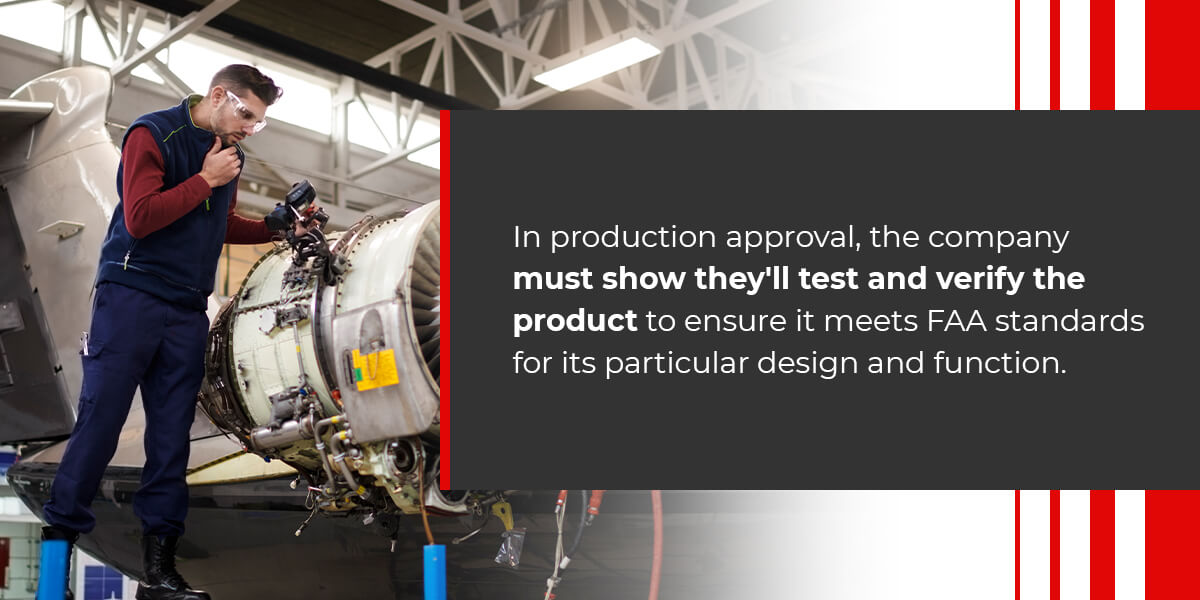
In production approval, the visitor must bear witness they'll test and verify the production to ensure it meets FAA standards for its item design and function. The agency will need to ensure that a system for production is in place to verify that each manufactured part matches the FAA-approved design.
Throughout the process, Manufacturing Inspection District Offices (MIDO) monitor and ostend production and quality systems to ensure the company tin can deliver a trustworthy aerospace component. These offices provide help for obtaining manufacturing certifications and production approval.
What Is an OEM Part?
OEMs have long been the leader in distributing disquisitional parts for aircraft in the aerospace industry, as these parts were originally the only option for equipment parts. The original manufacturer produces and installs the original parts for the equipment, and they make standardized products that will fit those precise specifications for replacement or repairs. These products have a record of established quality in design and performance when used in the original equipment.
OEM vs. PMA Comparison
PMA and OEM parts have somewhat different backgrounds, but they're subject field to the same industry standards. These options have 2 key metrics to compare — the quality and cost. As you consider OEM and PMA parts' differences and similarities, y'all can identify the all-time fit for your specific applications.
1. Quality of Parts
To become out on the market, both PMA and OEM products must undergo rigorous testing and meet standards requirements. PMA companies must navigate the in-depth approving process to ensure full compliance and product quality. OEM parts, meanwhile, have been proven successful through their use in the original equipment. Within the industry, established quality gates stipulate the material and pattern qualities that a production must take to be sold for use in equipment.
In the aerospace manufacture, the FAA's regulations ensure the quality of aftermarket parts remains consistent with the quality of OEM parts. Equally a result, the quality of the two is essentially the same. Oftentimes times the PMA'due south are from the same supplier the OEM uses. Additionally, in some cases, PMA components may have a slightly higher quality because manufacturers can address and resolve functional issues in the OEM.
ii. Price of Parts
In the past, OEMs were relied upon as the but choice for the best quality of parts. As a outcome, OEMs had piddling contest and kept prices high. However, as aftermarket replacement parts became more mutual, OEMs eventually adjusted pricing for specific components.
Today, manufacturers can however consummate PMA production for lower costs, leading to more cost-effective product offerings. PMA components don't compromise on quality while beingness readily bachelor at a lower price point than OEM parts.
When you're making a decision on which selection is best for your applications, yous'll want to consider the specific parts you need for your operations. Would a PMA adjustment be expedient for your equipment? Does your particular equipment wait exactly the aforementioned, whether it'south a PMA or OEM part? Evaluate your priorities and the options bachelor for your particular equipment.
Choose Reliable Parts With HRD Aero Systems
When y'all need trusted components for repairs or replacing equipment, HRD Aero Systems offers undecayed PMA products to meet your needs. As a PMA company, we're able to provide parts at a faster turnaround rate while coming together rigorous industrial standards. Additionally, we focus on providing custom solutions tailored to our client's specifications and applications, and we build trusted relationships with our clients to help offer tailored solutions.
Past maintaining an all-encompassing production inventory, we can rapidly exchange or sell units and offer same-solar day shipments. If you lot need repairs or other solutions, nosotros've been offering FAA-approved, world-course services for over three decades. Whatever your requirements, we offer prompt turnaround, 24-hour emergency assistance.
HRD Aero Systems is here to provide the solutions you need for your aerospace applications. As nosotros pursue continuous improvement, offer trusted products and provide exceptional customer service, we tin can address your operational requirements with reliable solutions. For more information on our product offerings, contact u.s. today .


Source: https://www.hrd-aerosystems.com/blog/pma-vs-oem-what-you-need-to-know/
Posted by: kratzolonstake90.blogspot.com
0 Response to "How Hard Is It To Get Pma After Getting A Repair Station"
Post a Comment